Games like Noita, where the physics is the real enemy
Playze Staff · Nov 5, 2026
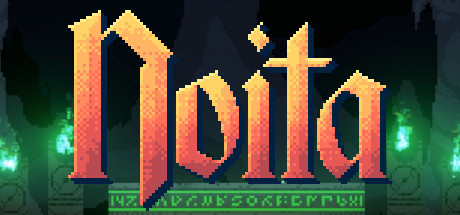
In Noita the fire you set does not stop at the edge of the enemy. It runs back along the oil you spilled getting there, drops through the floor you blew open two rooms ago, and finds you. That is what people actually miss when a run ends: not the permadeath, but a world where every pixel is simulated and nothing on screen is scenery.
Games like Noita usually get sold on the roguelite part, which is the least distinctive thing about it. The seven below are chosen for the other two — the wand you assemble yourself out of spell components, and a simulation that does not take your side.
| Game | Co-op | Low | Date | Store |
|---|---|---|---|---|
| Wizard of Legend | Split-screen | $3.34 | 25 Oct | Driffle |
| Risk of Rain Returns | Online, split-screen | $0.63 | 20 Oct | Gameseal |
| Rain World | No | $1.45 | 19 Oct | Driffle |
| Dwarf Fortress | No | $22.97 | 20 Oct | Driffle |
| Barony | Online, LAN, split-screen | $3.21 | 28 Oct | CJS CD Keys |
| Nuclear Throne | Split-screen | $1.30 | 28 Oct | Gameseal |
| Terraria | Online | $2.13 | 28 Oct | GAMIVO |

Nolla Games describes Noita as a world where every pixel is physically simulated, which is why fire here is a liability rather than a weapon. (Official Steam screenshot)
Games like Noita that keep the wand
Wizard of Legend is the closest any of these gets to the specific compulsion of building a terrible wand and firing it anyway. Its own description is explicit about the mechanic: you chain spells together to unleash combinations, from a pool of more than a hundred unlockable spells and relics, and the hand you assemble is meant to suit your own playstyle rather than a prescribed build. In practice that means the same loop Noita players recognise — pick up something you do not understand, slot it next to something you do, find out in the next room whether that was clever.
Where it parts company is speed and scope. This is a compact, fast dungeon crawler with hand-placed spell shops and council-member bosses, not a procedurally generated world you excavate; a run is minutes rather than an evening, and the combat is melee-range dodging rather than careful demolition from a safe distance. Contingent99 built it to be legible, and it is: you can see why you died. If you are coming off Noita's habit of killing you with your own fourth spell slot, Wizard of Legend gives you that bargain back in a form you can start and finish in a lunch break. Our record has its cheapest listing barely moving across the window above.
Hopoo's remake sells the other half of the wand problem: stacking. Risk of Rain Returns runs on unique loot combinations rather than crafted spells, and a long run is mostly watching items multiply off one another until the screen stops being readable — the same arithmetic as a wand with four triggers on it. Fifteen survivors change what those stacks do, and Risk of Rain Returns has been the cheapest thing here in our readings.

Wizard of Legend's spells are drawn from a pool of over a hundred, and chaining them is the whole combat system rather than a flourish. (Official Steam screenshot)
Every pixel still matters
You are a slugcat, and the food chain has not been arranged for your benefit. Rain World drops you into a broken ecosystem as both predator and prey, where the creatures hunt each other as readily as they hunt you, and where torrential rain periodically threatens to drown everything that has not found shelter. Videocult's animals run on their own routines rather than aggro radii, so a route that worked yesterday can be occupied today by something that has moved in. It asks for stealth and reading the environment rather than force, which is the Noita instinct exactly — the world is not tuned to your power level, so you work out what it is doing and go around. Rain World is also the one pick here that will frustrate anyone expecting a run-based structure; it is a survival platformer with shelters and progress, and it is slow.
Bay 12 Games promises the deepest, most intricate simulation of a world that has ever been created, and the claim is not marketing bluster — Dwarf Fortress generates the rise and fall of civilisations, cultures and individual personalities before you place a single workshop. What you do with it is manage a colony of dwarves who, as the Steam page cheerfully puts it, will probably mine towards their eventual demise. That is the Noita relationship with a simulated world, moved up a level of abstraction: you do not control outcomes, you set conditions and then watch physics, psychology and geology interact. Dwarves go mad. Aquifers flood tunnels. Something you dug towards for the right reasons turns out to have been holding the ceiling up.
The cost is the steepest learning curve in this piece by some distance, which the in-game tutorials only partly flatten. It is also the only pick here that is genuinely open-ended — there is no run to lose and no ending to reach, just a fortress that eventually falls. Dwarf Fortress is the most expensive game on this page in our record, and the one least likely to discount: our readings have its cheapest listing moving within a narrow band all window.
Perma-death past the Holy Mountain
Barony states its terms on the tin: perma-death, cryptic dungeons and no handholding. It is a first-person roguelike rather than a 2D one, built on classic roguelike systems — thirteen classes including a sexton and an arcanist, identifiable magical items, traps that are genuinely lethal, and a new dungeon every time. The cryptic part is the draw for Noita players, because like Noita it declines to explain its own systems and expects you to work them out across many short, fatal attempts. Barony also has the broadest co-op support of anything here, up to four players across online, LAN and split-screen, and that changes it considerably: the systems stay cruel but the dungeon becomes a comedy.
Vlambeer's wasteland shooter is the purest permadeath on this page. Nuclear Throne is top-down rather than side-on, and the only building you do is collecting radiation to mutate new limbs and abilities mid-run. It is extremely hard, admits as much in its own blurb, and Nuclear Throne has sat near the bottom of our price readings throughout.
Digging below the Mines
Terraria answers the descent rather than the death. Re-Logic's sandbox runs on the same impulse as tunnelling past Noita's Mines into whatever is under them: dig, fight, build, through caverns into biomes that get stranger the deeper you go. Nothing is physically simulated the way Noita's liquids are, so nothing here kills you with your own equipment. Terraria sits at 97% positive in our data, and our price piece on it tracks the longer run.

Terraria's biomes change as you dig, which is the part of Noita's descent it reproduces best. (Official Steam screenshot)
Spelunky 2 turns up on practically every shortlist for this, and the recommendation is sound — procedural levels, brutal deaths, physics that work against you. We have left it out because our record holds only four readings for it inside the window above, which is not enough to tell you anything useful. Caves of Qud, the other name that comes up constantly and the best simulation match of the lot, sits at two tracked sellers in our data, so there is nothing to compare.

Nolla Games' own 1.0 trailer, for the simulation these seven are measured against.
The next wand to pick up
Start with Wizard of Legend. Of everything here it is the one that reproduces the actual moment you miss — assembling an attack out of parts you only half understand and discovering the consequences at speed — and it does it in a game you can learn in an evening rather than a season. Our readings also have it steady: the highest and lowest figures we logged across the window sit within a tenth of each other, so there is no particular timing to it.
Dwarf Fortress is the better game and the wrong recommendation for most people leaving Noita, because it answers the simulation and discards the wand entirely; take it when you want a hobby rather than a run. And if you are still not finished with the original, our verdict on whether Noita is worth it goes through what you are committing to, while our roguelike round-up and the explainer on what a historical low actually means cover the wider genre and the numbers above.

Rain World's creatures hunt each other as well as you, which is why routes stop being reliable. (Official Steam screenshot)
We wrote this from store pages, published reviews and our own price record, not from playing each game for this piece. Some store links on our game pages are affiliate links, so playze may earn a commission at no extra cost to you.