Steam Deck vs Switch 2: which one is worth buying in 2026
Davit Darchiashvili · Sep 7, 2026

For three years the handheld argument had a tidy shape. The Nintendo machine was cheaper to buy and expensive to feed; the Valve machine cost more up front and then let you fill it from a library that discounts by ninety per cent. Work out how many games you would buy, and the answer fell out on its own.
2026 broke that. Steam Deck vs Switch 2 is now a harder question than it was in January, because both machines put their prices up within a hundred days of each other — and one of them went up roughly five times as much as the other. The old reasoning still works, but the numbers you feed it have moved a long way.
Steam Deck vs Switch 2: what actually changed this year
Valve moved first. In late May it raised the Steam Deck OLED from $549 to $789 for the 512GB model and from $649 to $949 for the 1TB, increases of $240 and $300. Its explanation was unusually blunt: "Steam Deck itself hasn't changed; these new prices reflect the current state of component costs and other global logistical challenges across the industry as a whole." The LCD models had already been discontinued, so there was no cheaper new Deck left to retreat to.
Nintendo followed. In a notice on its own site, Nintendo of America revised the Switch 2's US MSRP "from $449.99 to $499.99", beginning on 1 September 2026, "in response to various changes in market conditions, which are expected to extend over the medium to long term". Pricing for the original Switch was left alone.
All figures here are US MSRP as of 7 September 2026. The shape is what matters: a $50 rise on one side, a $240–$300 rise on the other. A Switch 2 and the cheapest new Steam Deck used to sit about a hundred dollars apart. They now sit nearly three hundred apart.
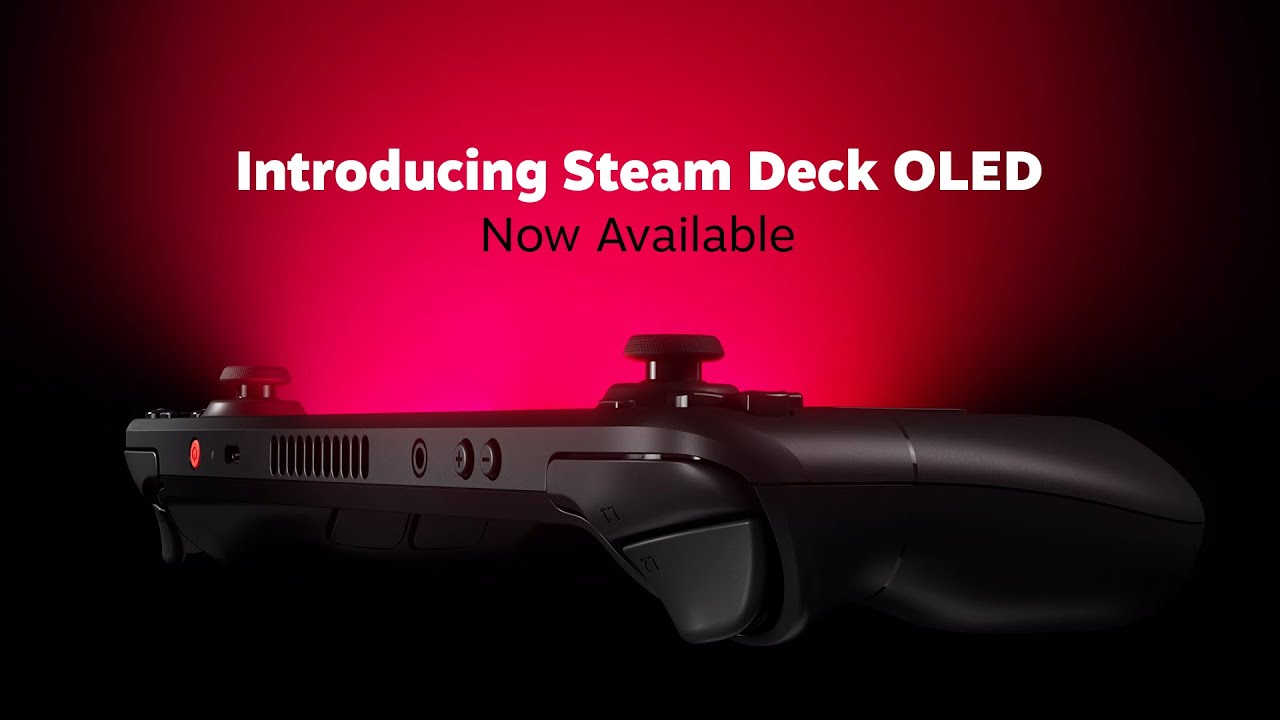
Valve's own OLED introduction. The hardware is unchanged since; only the price is not. (Valve's official channel)
The hardware, honestly
On the panel, Nintendo wins the spec sheet and Valve wins the picture. The Switch 2 has a 7.9-inch wide-colour-gamut LCD running 1920x1080 with HDR10 and variable refresh up to 120Hz. The Steam Deck OLED has a 7.4-inch HDR OLED running 1280x800 at up to 90Hz. More pixels and more hertz against better black levels and better contrast — which you prefer is genuinely a matter of taste, though 800p on a 7.4-inch screen is sharper in the hand than it reads on paper.
Battery is closer than the marketing suggests. Nintendo quotes roughly 2 to 6.5 hours for the Switch 2. Valve quotes 3 to 12 hours for the OLED Deck, from a 50Whr pack. Both ranges are honest, in that both are decided almost entirely by what you run.
Storage is where Nintendo is stingiest: 256GB of UFS, with expansion needing pricier microSD Express cards. The cheapest new Deck ships with 512GB of NVMe and takes an ordinary microSD. On television, Nintendo documents up to 4K at 60fps docked, and 120fps at 1080p and 1440p. The Deck is not that machine and has never pretended to be.

Cyberpunk 2077 was Nintendo's headline third-party launch title on Switch 2, and it is Steam Deck Verified on the other side. (Official Steam screenshot)
What each machine can actually play
The Switch 2 plays Switch 2 games, plus your existing Switch library — with a caveat Nintendo prints itself: the console "can play compatible physical and digital games released on Nintendo Switch", but "some Nintendo Switch games may not be supported on or fully compatible with Nintendo Switch 2". Check before you assume an old favourite carries over.
Its third-party slate is stronger than any previous Nintendo box. Nintendo's own launch announcement named Cyberpunk 2077: Ultimate Edition, Elden Ring Tarnished Edition, Street Fighter 6 and Sid Meier's Civilization VII, with Hades II, Hogwarts Legacy, Final Fantasy VII Remake Intergrade and Borderlands 4 alongside them.
Read that list again, because it is the crux of the whole comparison. Every single one of those games also exists on PC, where it is subject to a discount cycle the eShop does not have.

Elden Ring Tarnished Edition on Switch 2, Elden Ring on PC. Same game, two entirely different pricing regimes. (Official Steam screenshot)
The Deck's compatibility is better than its reputation
The standing objection to the Deck is that PC games are fiddly on Linux. That was fair in 2022 and is mostly out of date now. We checked Valve's own compatibility reports today for the six third-party games Nintendo used to sell the Switch 2, and every one of them — Cyberpunk 2077, Elden Ring, Street Fighter 6, Civilization VII, Hades II and Hogwarts Legacy — is rated Steam Deck Verified, the top tier, meaning controller support, legible text and a performant default configuration out of the box.
The honest counterexample is a brand-new one. Onimusha: Way of the Sword, released last week, is rated only Playable, and solely because some of its interface text is too small to read at the Deck's resolution; everything else passes. That is the usual shape of a Deck failure in 2026 — a menu you squint at, not a game that will not launch. We went through the rest of that game's launch in our PC verdict on it.

Street Fighter 6 shipped day one on Switch 2 and is Deck Verified. Its PC copy has been through several sale cycles. (Official Steam screenshot)
The maths that actually decides it
Here is the calculation, and it is the part that is actually about you. A Switch 2 and a 512GB OLED Deck are now about $289 apart. Against the 1TB Deck it is about $449.
So: list the ten games you genuinely intend to buy in the next two years. Open each on Playze, look at the live PC price across every store we track, and compare it with what the eShop asks. Add up the differences. When the running total clears the hardware gap, the Deck is the cheaper machine to own; until it does, it is not. Most people who buy a lot of third-party games clear it comfortably. People who buy four games a year do not.
Two rules keep that sum honest. First, count only games you will actually buy — a 90 per cent discount on something you would never have played saves you nothing. Second, use live prices rather than remembered ones, and know the difference between a good sale and a genuine historical low. Our price-tracking guide covers the timing side of it.

Civilization VII came to Switch 2 with mouse controls. On PC it has already had free-to-try weekends and half-price spells. (Official Steam screenshot)
The Nintendo games are the argument, and they always were
None of the above touches Mario, Zelda, Metroid, Pokémon or Mario Kart, and that is the point. Those games have no PC price, so they contribute nothing to the sum above and cannot be waited out either — Nintendo's first-party catalogue barely depreciates, for reasons we set out in why Nintendo games stay expensive.
Which makes the decision cleaner than the spec sheets suggest. If two or more Nintendo franchises are non-negotiable for you, buy the Switch 2 and stop reading comparisons; no amount of PC discounting substitutes for a game you cannot legally buy elsewhere. If they are not, the Deck's case survives even at the new price, because everything you want exists on the cheaper storefront.

The Switch 2 reveal Direct. The exclusives shown here are the part of the pitch no price comparison can touch. (Nintendo of America's official channel)
The cheapest sensible Deck is a refurbished one
One practical note that the price rise made important: Valve left the discontinued LCD models' prices alone, and sells refurbished units directly. A refurbished 512GB LCD Deck lists at $359 — which is not merely cheaper than a new Deck, it is well under the price of a Switch 2.
You give up the OLED panel, some brightness and a chunk of battery life. You keep the entire library argument intact, and the payback maths above stops being a maths problem at all, because you are ahead on hardware before you buy a single game. If the Deck appeals but $789 does not, that is the version to look at first. Our Steam Deck game picks run perfectly well on it.

Hades II is on both machines and Deck Verified — the kind of mid-price game where the library gap compounds fastest. (Official Steam screenshot)
The bottom line
Buy the Switch 2 if Nintendo's own games matter to you, or if you want the better screen, the simpler machine and a console someone else in the house can pick up without a tutorial. At $499.99 it is still the cheapest way into a first-party catalogue that does not exist anywhere else.
Buy a Steam Deck if your next ten purchases are third-party games — and buy the refurbished LCD unless you specifically want the OLED screen, because at $789 the new one now asks you to save roughly three hundred dollars in game prices before it breaks even, and that takes most people a couple of years rather than a couple of months.
What nobody should do is run the 2024 argument on 2026 prices. The Deck's library advantage is real and still compounds. It just starts from a much deeper hole than it did in January.